

Oil and gas capital came back. This time it wants the data first.
Howard Crosby of LGX Energy and Dean DeLisle of Regiment Securities break down where energy capital is moving, how 3D seismic lowers drilling risk, and where LGX fits across the Illinois Basin.
 Howard Crosby
CEO, LGX Energy
 Dean DeLisle
CRO, Regiment Securities
Reserve your seat
Register once. We will email your link and the recording.
Open to accredited investors. This page is for information and education. It is not an offer to buy or sell securities. Full disclosures below.
The difference between a lottery ticket and a development program.
The familiar knock on small oil plays was simple. You were betting on a hole in the ground. One well hits, the next three come up dry, and your money goes with them.
3D seismic changed that math. High-resolution imaging maps oil-bearing formations before the bit touches dirt, which turns a guess into a measured shot.
LGX built its plan around that edge. The company holds more than 600 miles of seismic data across the Illinois Basin, a region that has produced oil for over a century and still holds pay zones earlier tools could not read. From that data, LGX has identified drilling targets across several formations. That gives it something a single-well wildcatter never has: inventory.
Sit with that word. A deep set of mapped targets means one playbook runs again and again. Drill, evaluate, develop, then move to the next. Each result funds the following phase instead of ending the story. That line sits at the center of how LGX plans to grow.
Forty minutes, then the floor is yours.
- Where private capital is moving in energy right now
- How 3D imaging lowers the risk profile of a drilling program
- What repeatable, multi-zone economics mean for reserves over time
- Where LGX stands today and what the development roadmap looks like
- How the Reg D 506(c) offering is structured for accredited investors
A century-old producing region, read with current technology.
The Illinois Basin rarely makes headlines. It has quietly fueled American energy for generations.
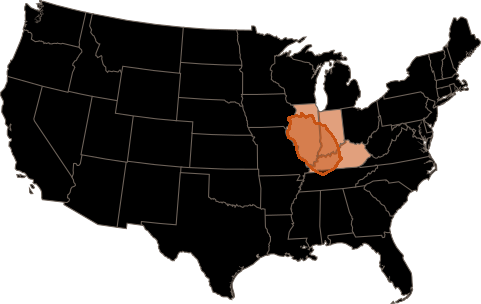
Spread beneath Illinois, Indiana, and Kentucky, the basin has produced billions of barrels across more than a hundred years. Many fields were found before geologists had computers or a clear picture of what lay below. Crews drilled on instinct and thin data. Plenty of wells produced for decades. Others were walked away from once operators believed they had reached the limit.
The tools are different now. Modern 3D seismic reveals formations, faults, and reservoir structures that earlier crews could not see. In places it surfaces prospects that were effectively invisible when the basin was first developed.
For investors, the pairing is the draw: proven geology read with twenty-first-century data. LGX builds its strategy around that intersection, which puts the Illinois Basin at the center of the conversation.
Two operators who have done this before.
Crosby has spent four decades building natural-resource companies. In the early 2000s he took over Cadence Resources, then an over-the-counter company worth under a million dollars, and grew it into an oil and gas operation valued in the hundreds of millions before its 2006 sale. He went on to found and list uranium and silver ventures that were later acquired at sizable gains. LGX marks his return to oil and gas, this time in the Illinois Basin.
DeLisle started on the floor of the Chicago Board of Trade in 1982 and has worked in capital markets since. Across three decades he has raised more than $2.5 billion for clients and had a hand in five IPOs. At Regiment he runs capital raising and investor education, and he holds FINRA Series 7 and 63 licenses.
Bring your questions. This is a discussion, and there will be time for them.
Save your seat for August 6.
Thu, Aug 6, 2026 · 2:00 PM CDT · Online via Demio · Recording sent to all who register
Reserve my seat